Appearance
Plan Burn Editor
Overview
The Plan Burn Editor is a specialized prescribed fire planning system designed for professional burn operations management and EMSINA-compliant mapping. This advanced tool integrates ArcGIS drawing tools with specialized burn operation workflows, providing comprehensive mapping capabilities with professional fire management symbols, advanced geometric operations, and intelligent layer management optimized for prescribed burn planning, execution, and documentation.
Key Features:
- EMSINA Standard Compliance: Professional fire management symbols and mapping standards for prescribed burn operations
- Comprehensive Burn Planning Workflow: Complete support for burn area design, ignition planning, and safety zone mapping
- Specialized Symbol Library: 20+ professional burn operation symbols including ignition points, water sources, assembly areas, and fire breaks
- Advanced Drawing Integration: ArcGIS drawing tools with coordinate transformation and spatial reference handling
- Intelligent Layer Management: Automatic creation of Plan Burn data layer groups with proper categorization
- Integrated Advanced Editor: Built-in geometric operations for buffer, union, intersect, and difference operations
- Multi-Mode Support: Single and multiple feature drawing capabilities for enhanced productivity
Getting Started
Opening the Plan Burn Editor

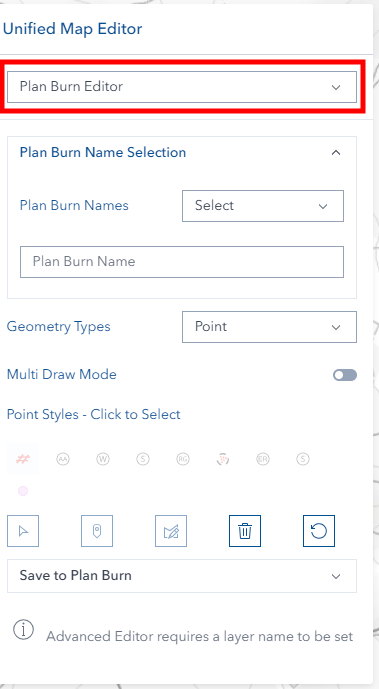
- Look for the Unified Editor icon (pencil) on the right toolbar
- Click the icon to open the editor panel
- Select Plan Burn mode from the mode selector at the top
What You Can Do
- Create burn operation plans with EMSINA standards
- Map ignition points, fire breaks, and burn boundaries
- Plan water sources and emergency assembly areas
- Create detailed burn progression maps
Layer Management
Setting Up Layer Names
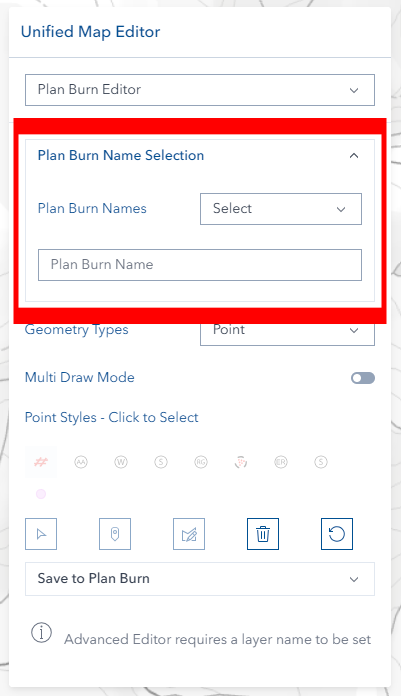
Before you can start drawing, you need to set a layer name:
- Use Dropdown: Select an existing plan burn name from the Plan Burn Names dropdown (refreshes on click)
- Type New Name: Enter a new burn plan name in the text field below the dropdown
- Wait for Activation: Drawing tools become available once a name is set
The system automatically creates appropriate Point, Polyline, and Polygon data layers for your burn plan when you provide a layer name.
Filter by Name
The Filter by Name toggle restricts the map display to features belonging to the selected plan burn name:
- Select an existing name from the Plan Burn Names dropdown
- Toggle Filter by Name on
- All plan burn layers (points, lines, polygons) filter to show only features with that name
- Toggle off to show all plan burn features
WARNING
The filter only responds to names selected from the dropdown. Typing a name in the text field activates the editor for drawing, but does not apply the filter.
TIP
While the filter is on, changing the dropdown selection automatically re-applies the filter to the new name.
Geometry Types

Choose the geometry type that matches what you want to create:
Point Features
- Best for: Ignition points, water sources, assembly areas, equipment locations
- Examples: Landing zones, rain gauges, escape routes, hazard markers
Line Features
- Best for: Fire breaks, burn lines, section boundaries, direction arrows
- Examples: Strip lighting patterns, containment lines, hand lighting paths
Polygon Features
- Best for: Burn areas, zones, constraints, boundaries
- Examples: Burn boundaries, planned burn areas, hazard zones, constraints
Style Selection
Choosing Styles
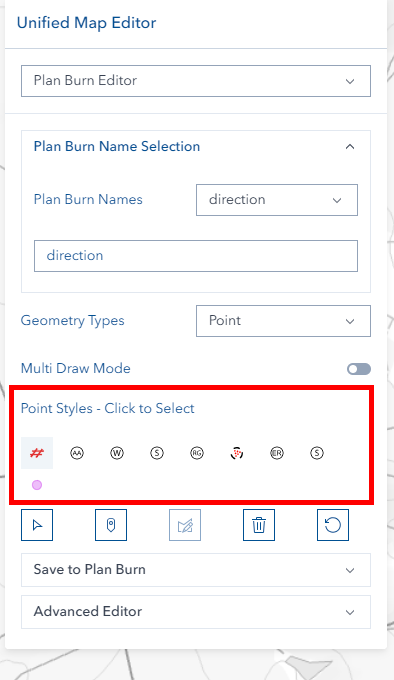
- Set your layer name first (styles are disabled until you do)
- Select your geometry type (Point, Line, or Polygon)
- Click on any style icon to select it
- The selected style will be highlighted with EMSINA standard symbols
Point Styles
| Icon | Style Name |
|---|---|
 | Landing |
 | Assembly Area Point |
 | Water Point |
 | Hazard Sticks |
 | Rain Gauge |
 | Aerial Ignition |
 | Escape Route |
 | Special Point |
 | Electronic Sticks Point |
 | Not Coded |
Line Styles
| Icon | Style Name |
|---|---|
 | Strip Light |
 | Spot Light |
 | Fire Break |
 | Direction Arrow |
 | Section Boundary |
 | Historic Lines |
 | Hand Lighting |
 | Text Line |
 | Burn Plan Area |
| Drivable Fire Break |
 | Not Coded |
Polygon Styles
| Icon | Style Name |
|---|---|
 | Burn Boundary |
| Burn Plan Area |
 | Constraint |
 | Hazard |
| Fire Break |
 | Constraint 1 |
 | Constraint 2 |
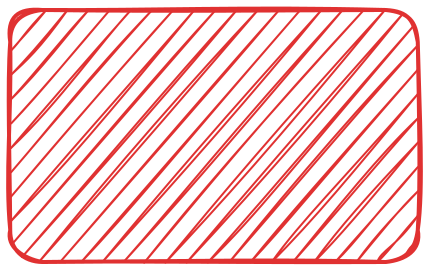 | Constraint 3 |
 | Vegetation Constraint |
 | WTE exclusion zone |
 | Unknown |
Special Options
Text Options: For Text Line style, enter display label and choose font size (8, 10, 15, 20, 30, 36pt). A display label is required — saving will fail without one.
Drawing Features
Before You Start
- ✅ Set a layer name
- ✅ Choose geometry type
- ✅ Select an EMSINA standard style
Toolbar Toggles
Three toggles are available before drawing, followed by the Line style picker:
| Toggle | Description |
|---|---|
| Multi | Keep the drawing tool active so you can draw the next feature immediately |
| Meas | Show real-time length (metres) and area (hectares) while drawing |
| Label | Toggle labels on/off for all Plan Burn data layers on the map |
The switch labels are abbreviated so they fit on one line beside the Line style picker; hover any switch to see its full description.
TIP
The Label toggle starts on by default.
Line Style — Straight or Arc
The Line style picker at the end of the toggle row has two icon buttons that control how the line tool reads your clicks:
- Straight (default) — every click is a vertex, joined by straight segments.
- Arc — the first click starts the line, then each pair of clicks is a point to curve through followed by the curve's end point. Repeat for each further curve; a reminder line appears under the row while Arc is selected.
The curve appears live as you click, and a finished arc is stored as closely-followed vertices, so measurement, saving and everything downstream behaves exactly as it does for a straight line. Points and polygons are unaffected. See Line Style for the full explanation, including when a curve deliberately stays straight.
Drawing Steps
For Points:
- Click the Point draw button
- Click on the map where you want the burn operation point
- The point appears immediately with EMSINA symbology
For Lines:
- Click the Line draw button
- Click points along your desired burn line or boundary
- Double-click to finish the line (or press ESC to cancel)
For Polygons:
- Click the Polygon draw button
- Click points around your burn area
- Double-click to close the polygon (or press ESC to cancel)
Visual Feedback
- Draw buttons light up when active
- Disabled buttons show helpful tooltips
- EMSINA standard symbols appear on the map as you draw
Feature Information
When you save features, the system automatically records:
- Layer name
- Display label (if provided)
- EMSINA style attributes
- Username for tracking
- Creation timestamp
Managing Features
Selecting Features
- Click the Select button (requires layer name)
- Click any plan burn feature on the map
- Feature information loads into the editor
- Current EMSINA style is detected and displayed
Editing Features
- Select a feature first
- Click the Edit button
- Use the editing tools to modify the geometry:
- Move vertices by dragging them
- Add vertices by clicking on edges
- Delete vertices by selecting and pressing Delete
- Move entire features by dragging
- Click Save when finished
Deleting Features
- Select the feature you want to delete
- Click the Delete button (trash icon)
- Confirm when prompted
- The feature is removed and layers refresh automatically
Advanced Features

Multiple (Continuous Drawing) Mode
The Multi toggle (tooltip: Multiple Mode) controls whether the drawing tool stays active after each feature is placed.
Multiple OFF (Default):
- Draw one feature, then the tool deactivates
- Click the draw button again to draw another feature
Multiple ON:
- The drawing tool stays active after each feature is completed
- Keep clicking on the map to rapidly create many features
- Click the draw button again or press ESC to stop
INFO
Regardless of Multiple mode, every drawn shape is always saved as a separate feature in the layer.
INFO
Switching to a different draw button (e.g., from Polygon Draw to Point Draw) resets the Multiple toggle to off.
Advanced Editor

When you have a layer name set, the Advanced Editor becomes available for complex burn planning operations:
- Union: Combine multiple burn areas into unified zones
- Buffer: Create safety buffer zones around burn features
- Difference: Create exclusion zones by subtracting protected areas
- Intersection: Find overlapping areas between burn zones and constraints
- Cut: Split burn areas using cutting lines
Professional Burn Planning Applications
Union Operations: Combine multiple planned burn patches into single operational units
Buffer Operations: Create safety zones around:
- Water sources and supply points
- Assembly areas and escape routes
- Sensitive environmental areas
Difference Operations: Exclude protected areas from burn boundaries:
- Wildlife habitat zones
- Cultural heritage sites
- Infrastructure protection areas
Intersection Analysis: Identify overlaps between:
- Burn zones and environmental constraints
- Multiple burn unit boundaries
- Operational areas and safety zones
Tips & Troubleshooting
Common Issues
| Problem | Solution |
|---|---|
| Drawing buttons are grayed out | Set a layer name first — either select from the dropdown or type in the text field |
| Drawing tools not activating | Not Coded (Unknown) styles disable drawing — select a named style instead |
| Can't select features | Ensure layer name is set and plan burn features exist on the map |
| Edit mode not working | Select a feature first, then click the Edit button |
| Text line won't save | Enter text in the Display Label field — Text Line style requires a display label; saving fails without one |
| Filter not showing features | Select a name from the Plan Burn Names dropdown — typing in the text field does not apply the filter |
| Multiple resets unexpectedly | Switching to a different draw button resets Multiple to off |
Best Practices for Burn Planning
- Start with boundaries: Create burn boundaries first, then add internal features
- Use EMSINA standards: All symbols follow EMSINA guidelines for consistency
- Plan escape routes: Always include escape routes and assembly areas
- Mark water sources: Identify all available water sources and access points
- Consider weather: Use rain gauge locations for weather monitoring planning
- Safety first: Mark all hazards and create appropriate safety zones
Working with Text Lines
- Select the Text Line style
- Enter your label text in the Display Label field
- Choose font size from the dropdown (8, 10, 15, 20, 30, 36pt)
- Draw the line where you want the text to appear
- Text will render along the line path