Appearance
Wildfire Editor
The Wildfire Editor is a comprehensive emergency response mapping system designed for wildfire incident management and operational support. This specialized tool integrates ArcGIS drawing tools with professional wildfire response workflows, providing advanced mapping capabilities with industry-standard emergency symbols, real-time incident documentation, and intelligent layer management optimized for emergency response operations, incident command support, and wildfire management activities.
Quick Start Guide

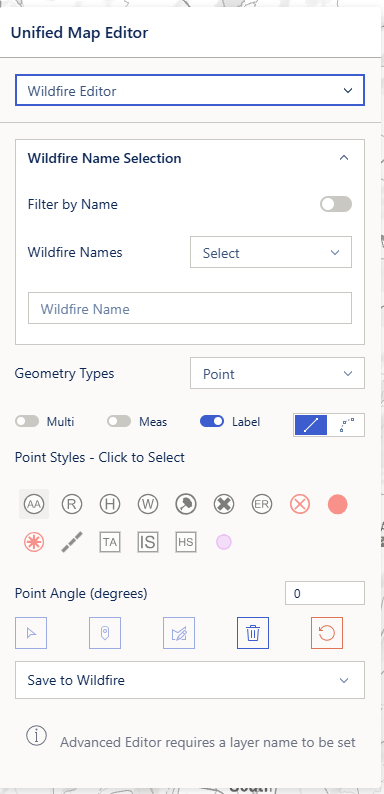
Opening the Wildfire Editor:
- Click the Unified Editor icon (pencil) in the right toolbar
- Select Wildfire mode from the mode selector dropdown
- Enter or select a wildfire name to begin mapping
Essential Actions:
- Name Selection: Choose from existing wildfire names or create new ones
- Feature Drawing: Create points, lines, and polygons with specialized wildfire symbols
- Multiple Mode: Enable continuous drawing for rapid feature creation
- Advanced Operations: Access geometric operations through the integrated advanced editor
Key Features
Wildfire Name Selection

The Wildfire Name Selection accordion at the top contains all name and filter controls:
- Use Dropdown: Select an existing wildfire name from the Wildfire Names dropdown (refreshes on click)
- Type New Name: Enter a new wildfire name directly in the text field below the dropdown
- Wait for Activation: Drawing tools and style icons become enabled once a name is set
Filter by Name
The Filter by Name toggle restricts the map display to features belonging to the selected wildfire name:
- Select an existing name from the Wildfire Names dropdown
- Toggle Filter by Name on
- All wildfire layers (points, lines, polygons) filter to show only features with that name
- Toggle off to show all wildfire features
WARNING
The filter only responds to names selected from the dropdown. Typing a name in the text field activates the editor for drawing, but does not apply the filter.
TIP
While the filter is on, changing the dropdown selection automatically re-applies the filter to the new name.
Specialized Wildfire Symbology
The editor uses industry-standard symbols for wildfire mapping, organized by feature type:
Point Features:
- Assembly Area
- Refuge Area
- Helipad
- Water Point
- Dangerous Tree
- Road Closure
- Escape Route Point
- Fire Origin
- Hot Spot
- Spot Fire
- Sector Boundary
- Threatened Asset
- Indigenous Site
- Historic Site
- Not Coded
Line Features:
- Active Fire Edge
- Predicted Fire Edge
- Fire Boundary (not active)
- Control Line - Proposed
- Control Line - Complete
- Back Burn - Proposed
- Back Burn - Complete
- Machine Cut Track
- Escape Route Line
- Text Line (font size fixed at 10pt; display label required — saving fails without one)
- Not Coded
Polygon Features:
- Burnt Area (Current incident)
- Burnt Area (Previously)
- Not Coded
Geometry Type Selection

Switch between different feature types based on mapping needs:
- Points: For specific locations and infrastructure
- Lines: For boundaries, routes, and linear features
- Polygons: For areas and zones
Multiple Mode Drawing
The Multi toggle (tooltip: Multiple Mode) controls whether the drawing tool stays active after each feature is placed.
Multiple OFF (Default):
- Draw one feature, then the tool deactivates
- Click the draw button again to draw another feature
Multiple ON:
- The drawing tool stays active after each feature is completed
- Keep clicking on the map to rapidly create many features
- Click the draw button again to stop
INFO
Regardless of Multiple mode, every drawn shape is always saved as a separate feature in the layer.
INFO
Switching to a different draw button (e.g., from Polygon Draw to Point Draw) resets the Multiple toggle to off.
Point Angle Control
For point features that require directional orientation, specify angles from 0–359 degrees. This is essential for:
- Directional symbols
- Equipment orientation
- Access route indicators
INFO
The angle resets to 0 when you switch to the Point geometry type.
Layer Management
Automatic Layer Creation
Wildfire layers are created automatically when you:
- Select a wildfire name from the dropdown
- Type a new wildfire name
- Begin drawing features
The system creates three data layers:
- Wildfire Points
- Wildfire Lines
- Wildfire Polygons
Graphics Layer Organization
Temporary graphics appear on top of data layers during editing, organized into:
- Target graphics (current drawing/editing)
- Reference graphics (for spatial operations)
- Advanced editor graphics (for geometric operations)
Drawing and Editing Features
Toolbar Toggles

Three toggles are available before drawing, followed by the Line style picker:
| Toggle | Description |
|---|---|
| Multi | Keep the drawing tool active so you can draw the next feature immediately |
| Meas | Show real-time length (metres) and area (hectares) while drawing |
| Label | Toggle labels on/off for all Wildfire data layers on the map |
The switch labels are abbreviated so they fit on one line beside the Line style picker; hover any switch to see its full description.
TIP
The Label toggle starts on by default.
Line Style — Straight or Arc
The Line style picker at the end of the toggle row has two icon buttons that control how the line tool reads your clicks:
- Straight (default) — every click is a vertex, joined by straight segments.
- Arc — the first click starts the line, then each pair of clicks is a point to curve through followed by the curve's end point. Repeat for each further curve; a reminder line appears under the row while Arc is selected.
The curve appears live as you click, and a finished arc is stored as closely-followed vertices, so measurement, saving and everything downstream behaves exactly as it does for a straight line. Points and polygons are unaffected. See Line Style for the full explanation, including when a curve deliberately stays straight.
Before You Start
- Enter or select a wildfire name
- Choose a geometry type (Point, Line, or Polygon)
- Select a style from the symbol palette
Style Selection
Choose appropriate symbols before drawing by clicking style buttons. Each geometry type has its own style palette with visual icons representing different wildfire features.
Drawing Process
- Select Style: Click the appropriate style button for your feature type
- Start Drawing: Click the draw button for your geometry type
- Create Feature: Click on the map to place points, or click and drag for lines and polygons
- Complete Feature: Double-click to finish lines and polygons (or press ESC to cancel)
Multiple Feature Creation
With Multiple Mode enabled:
- Draw multiple features without deactivating the drawing tool
- Maintain the same style across multiple features
- Quickly document extensive wildfire areas
Feature Selection and Editing
- Select: Use the select tool to choose existing features for modification
- Edit: Reshape feature geometry using the edit tool
- Delete: Remove selected features from the map and database
Advanced Geometric Operations

The integrated Advanced Editor provides sophisticated geometric tools:
Buffer Operations
Create buffer zones around features for:
- Safety perimeters around dangerous areas
- Access restrictions zones
- Equipment placement areas
Union Operations
Combine multiple features into single entities:
- Merge overlapping burnt areas
- Consolidate control line segments
- Combine related infrastructure points
Intersection Analysis
Find overlapping areas between features:
- Identify areas where multiple hazards overlap
- Analyze control line effectiveness
- Assess resource accessibility
Difference Operations
Remove one area from another:
- Subtract protected areas from operational zones
- Create exclusion zones within larger areas
- Define specific access corridors
Data Management
Saving Features
All wildfire features include:
- Unique object identifiers
- Wildfire name associations
- Feature type classifications
- Optional display labels
- User attribution
- Timestamp information
Display Labels
Add descriptive text to features for:
- Identification purposes
- Status updates
- Operational notes
- Resource specifications
WARNING
The Text Line style requires a display label. Saving will fail if no label is entered.
Layer Refresh
The system automatically refreshes data layers when:
- New features are saved
- Existing features are modified
- Features are deleted
- Advanced operations are completed
Integration with Other Tools
Layer Panel Coordination
Wildfire layers appear in the main layer panel with full functionality:
- Visibility control
- Transparency adjustment
- Legend display
- Layer information access
Print and Export Compatibility
Wildfire features are included in:
- Map printing operations
- Data export functions
- Report generation
- Analysis workflows
Performance Optimization
Efficient Drawing
- Use Multiple Mode for bulk feature creation
- Group related features by type
- Apply consistent styling within incidents
Layer Management Steps
- Remove unused wildfire graphics when switching incidents
- Keep data layers active for reference
- Use appropriate zoom levels for detail work
Troubleshooting
| Issue | Solution |
|---|---|
| Cannot draw features | Set a wildfire name first, then select a style — both are required before drawing |
| Drawing tools not activating | Unknown (Not Coded) styles disable drawing — select a named style instead |
| Text Line won't save | Enter text in the Display Label field — Text Line style requires a display label |
| Advanced editor disabled | Set a wildfire name first before accessing advanced tools |
| Multiple resets unexpectedly | Switching to a different draw button resets Multiple to off |
| Point angle not applying | Ensure angle is between 0–359 degrees; the angle resets to 0 when switching to Point geometry |
| Filter not showing features | Select a name from the Wildfire Names dropdown — typing in the text field does not apply the filter |
| Features not visible after saving | Check layer visibility in the layer panel; verify the wildfire name matches the layer name |
Best Practices
Incident Documentation
- Use consistent naming conventions for wildfire incidents
- Apply appropriate symbols for each feature type
- Include descriptive labels for operational clarity
- Document features in logical sequence
Data Quality
- Verify feature placement accuracy
- Use appropriate geometry types for each feature
- Apply correct symbology standards
- Include relevant attribute information
Operational Efficiency
- Plan feature creation workflow before drawing
- Use Multiple Mode for similar feature types
- Group related operations together
- Save work frequently during large mapping sessions
Collaboration
- Follow organizational naming standards
- Use standardized symbols consistently
- Include clear labels for team communication
- Maintain data currency for operational use
The Wildfire Editor provides essential tools for emergency response mapping, combining specialized symbology with advanced geometric operations to support comprehensive wildfire incident documentation and management.
Video Tutorials
Adding Wildfire Data
Modifying Wildfire Data
Deleting Wildfire Data
Using Advanced Tools
See Also
- Plan Burn Editor - EMSINA-compliant prescribed burn planning
- Advanced Editor - Standalone geometric operations tool
- Print Panel - Print wildfire incident maps